
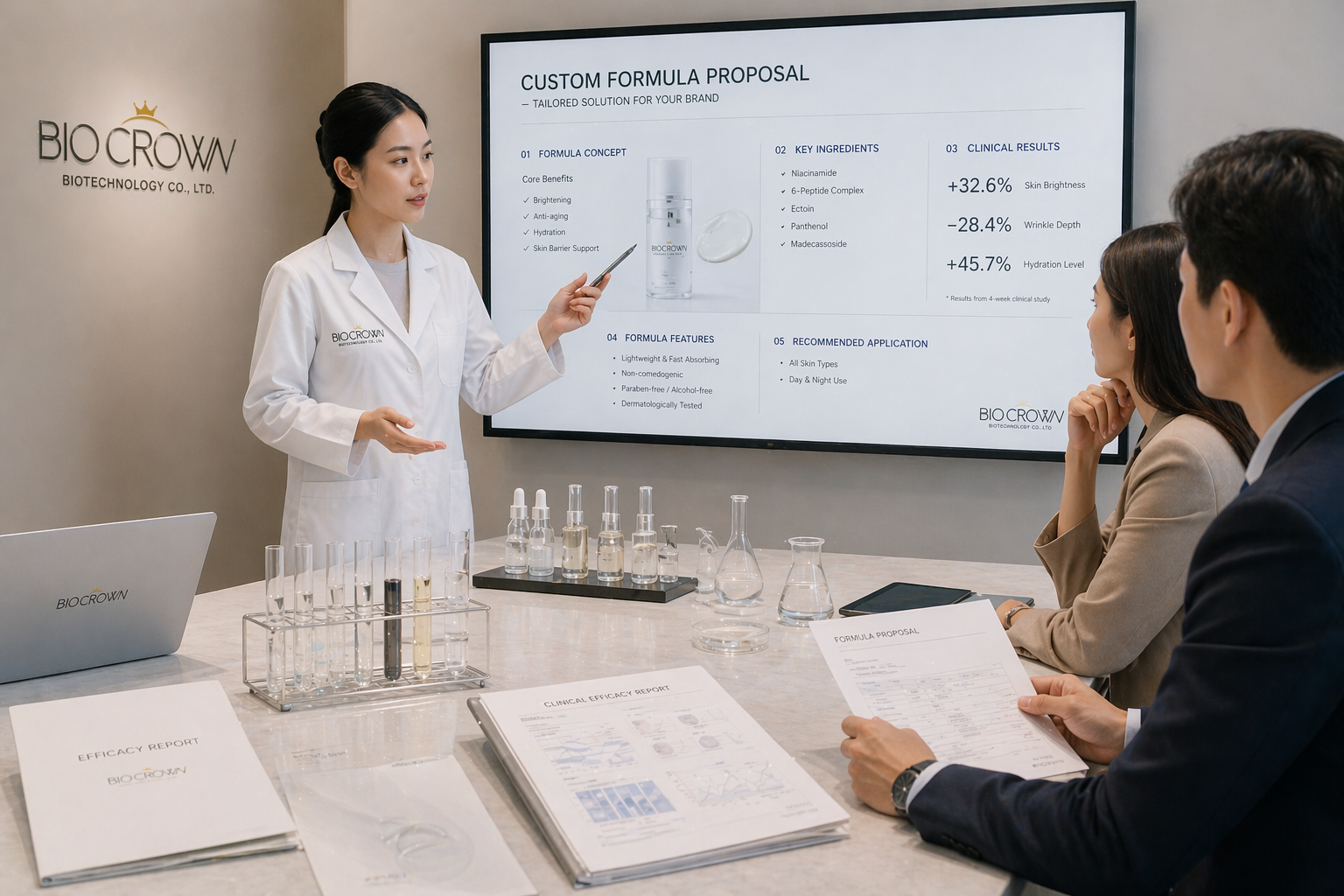
From Lab Sample to Mass Production: What Changes and Why It Matters
This is one of the most common — and most underestimated — challenges in cosmetic product development. The transition from a 500g lab sample to a 500kg production batch is not simply a matter of scaling numbers. It is a fundamentally different manufacturing environment, and every variable that was easy to control at small scale becomes harder to manage at volume.
At BIOCROWN, we have guided hundreds of formulations through this transition. This article explains precisely what changes during scale-up, why those changes occur, and the systems we have built to ensure your production batch is as close to your approved sample as science and engineering allow.
The Gap No One Warns You About
You have approved the lab sample. The texture is right. The scent is balanced. The stability data looks clean. You are ready to launch. Then the first production batch arrives,a nd something is different. The emulsion is slightly thinner. The active feels less immediate on skin. The color has shifted by half a shade. Nothing is catastrophically wrong, but it is not quite what you signed off on in the lab. Your launch timeline is now at risk, and you are left wondering: what happened between the bench and the factory floor?
Why Scale-Up Is Not Simply Multiplication
The intuitive assumption is that if a formula works at 1 kilogram, it will work identically at 1,000 kilograms, as long as the ratios remain constant. In practice, this assumption fails for several interconnected reasons.

1. Heat Transfer and Mixing Dynamics Change Fundamentally
In a laboratory setting, a 500g emulsion can be heated uniformly in a glass beaker within minutes. At production scale, a jacketed vessel heats from the outside in. The thermal gradient across a large batch is measurable, and it affects how emulsifiers behave, how waxes melt and recrystallize, and how oil and water phases combine during homogenization. Impeller geometry also changes at scale. The shear force generated by a high-speed laboratory homogenizer is not directly reproducible by a production-scale inline homogenizer. Droplet size distribution in an emulsion, which directly affects skin feel, absorption rate, and long-term stability, can shift meaningfully if homogenization parameters are not precisely defined and held.
2. Raw Material Variability Becomes Amplified
At lab scale, a formulator typically works from a single lot of each raw material. At production scale, you may be drawing from multiple drums or different sourcing batches within the same lot number. Natural-origin ingredients, botanical extracts, plant-derived emollients, fermentation-derived actives, carry inherent variability in odor profile, color, viscosity, and active marker concentration. A 0.3% variation in the saponification value of a plant-derived emollient may be invisible at 500g. At 300kg, it can alter the final emulsion viscosity by a clinically perceptible margin.


3. Processing Time Affects Ingredient Integrity
A lab formulator can complete a full emulsion in under an hour. A production batch of the same formula may require four to six hours of total processing time, including heating, homogenization, cooling, and transfer. For thermally sensitive actives, extended processing time at elevated temperature is a real degradation risk, not a theoretical one. Vitamin C derivatives begin oxidative degradation above 40°C. In a lab setting, the cool-down phase is rapid. In a large-scale batch, the cooling curve is significantly slower. Without process controls that account for this, the active concentration in the finished batch may be measurably lower than in the approved sample.
How BIOCROWN Manages the Gap: Three Core Systems
Understanding the problem is the first step. The more important question for any brand evaluating a manufacturing partner is: what do you actually do about it? At BIOCROWN, our approach to scale-up consistency is built on three interconnected systems, each targeting a different point in the manufacturing chain where deviation is most likely to occur.
System 1: Incoming Quality Control (IQC)
The most common source of batch-to-batch variation is not the manufacturing process itself, it is the raw materials entering that process. BIOCROWN's IQC protocol requires that every incoming lot of a critical ingredient is tested against defined internal specification ranges before it is released for use in any batch. This is a more demanding standard than simply accepting a supplier's Certificate of Analysis. For high-sensitivity actives, we maintain tighter internal acceptance criteria that reflect what the formulation actually requires, not just what the supplier guarantees. If a raw material lot falls outside our acceptance range, it does not enter production, regardless of whether it technically passes the supplier's own specification.
System 2: Process Parameter Standardization and In-Process Controls
Once a formula has been developed and approved, BIOCROWN's production team translates it into a fully standardized manufacturing specification. This is not simply a list of ingredients and quantities. It is a documented process protocol that defines Temperature profiles / Mixing parameters / Homogenization specifications / Phase addition sequence
System 3: Batch Manufacturing Records, Full Release Testing, and Retained Sample Stability Monitoring
Every production batch at BIOCROWN generates a Batch Manufacturing Record (BMR), a complete, time-stamped documentation of every step in the manufacturing process, every IPC result, every operator action, and every deviation from standard procedure. The BMR is not simply a compliance document. It is the full traceability chain for that batch, from raw material lot numbers through to finished goods release.
Before any batch is released for shipment, it undergoes full finished goods release testing against the approved product specification. This includes physical parameters (viscosity, pH, appearance, specific gravity), microbiological safety, and where relevant, active content verification. A batch that does not meet its release specification does not leave our facilit.

What This Means for Your Brand
The gap between lab sample and production batch is not a sign of poor formulation. It is a structural feature of how cosmetic manufacturing works at scale. The question is not whether variables will change, but whether your manufacturing partner has the systems to anticipate, measure, and control those changes before they reach your finished product. When you evaluate a OEM/ODM manufacturer, the right questions to ask are not only about certifications and capacity: How do you qualify raw material lots between the approved sample and the production batch? What in-process controls are documented in your manufacturing SOPs, and at what points are batches held for evaluation? What does your finished goods release protocol require before a batch ships? How long do you retain production samples, and under what stability conditions?
At BIOCROWN, these are questions we answer with documented procedures and verifiable records, not assurances. Our consistency is built on IQC, standardized process parameters, and a release protocol that treats every batch as if your brand's reputation depends on it. Because it does.

A Final Note on Partnership
The most effective way to minimize scale-up risk is to involve your manufacturing partner early, not at the point of handing over a finalized formula, but during the development phase, when process-informed formulation decisions can still be made. At BIOCROWN, our formulation scientists and production engineers work in parallel from the earliest stages of development. When a formula is being designed, we are already asking: how will this behave in a jacketed vessel? How will this active hold up across a multi-hour production cycle? What raw material specification window do we need to maintain to keep this emulsion consistent at scale? These are not just manufacturing questions. They are formulation questions and addressing them early is the reason our production batches consistently reflect the samples our clients approve.
Want to see how BIOCROWN can streamline your product development, from initial brief to full-scale production? We’d love to offer you a free technical consultation. Contact us to get started!
Related Articles
https://www.biocrown.com.tw/en/blog/5-Useless-Skincare-Habits-That-Are-Ruining-Your-Skin.html