
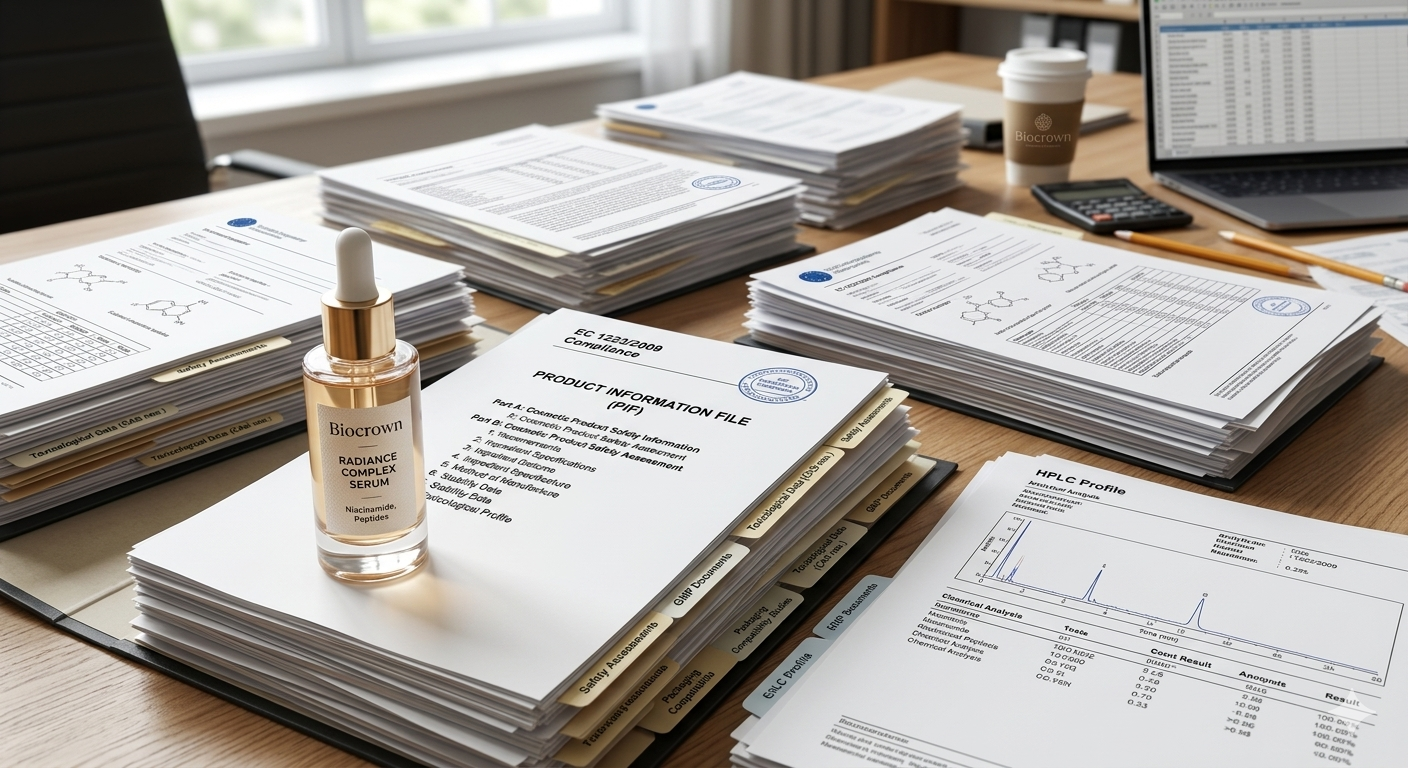
What Local Distributor Needs to Know, and How BIOCROWN Supports Every Step
You have found the right manufacturer. The formulation is approved. The packaging is ready. Then someone asks: "Do we have the PIF?"
If you are distributing or launching a cosmetic product in Vietnam, Myanmar, or Thailand, a Product Information File, commonly referred to as a PIF, is not optional. It is the document package that your local regulatory authority requires before your product can legally enter the market. BIOCROWN handles the manufacturing side of your PIF documentation. This article explains what a PIF is, what each country specifically requires, and exactly what we provide to make your registration process as straightforward as possible.
What Is a PIF, and Why Does It Matter?
A Product Information File is a structured dossier that proves your cosmetic product is safe, properly formulated, and accurately labeled for the market it is entering. Think of it as your product's passport — without it, the product cannot legally cross the border. Each country in Southeast Asia has its own regulatory framework, but the core logic is the same: the local authority wants to know what is in the product, who made it, and whether it is safe for consumers. The PIF is not filed by the manufacturer. It is filed by your local responsible entity, your distributor, importer, or local brand representative. BIOCROWN's role is to supply you with the technical documentation that forms the backbone of that submission. What you do with those documents in-country is managed by your local regulatory agent.
Country by Country: What You Need to Know

Vietnam
Regulatory Authority: Drug Administration of Vietnam (DAV), under the Ministry of Health. Vietnam requires a cosmetic notification submitted through the ASEAN Cosmetic Notification System. Before a product can be notified, the local responsible entity must prepare a complete PIF. What Vietnam's PIF typically requires? Product Information, Full INCI ingredient lis, A product safety report, GMP Certificate, Certificate of Free Sale, Product Specification & Testing Reports, Vietnamese-language label. The notification is valid for 5 years and must be renewed. Products cannot be sold before notification is confirmed.
Myanmar
Regulatory Authority: Food and Drug Administration (FDA) Myanmar, under the Ministry of Health and Sports. Myanmar requires pre-market registration for cosmetics, this is a more formal approval process compared to Vietnam's notification system. Products must receive a registration number before import or sale. What Myanmar's PIF typically requires? Application Form, Full ingredient list (INCI nomenclature preferred), Manufacturing License, GMP Certificate, Certificate of Free Sale, CoA, Stability Data Summary, Product Label, SDS. The registration process can take 3 to 6 months. Plan your market entry timeline accordingly. Renewal is typically required every 3 years.


Thailand
Regulatory Authority: Food and Drug Administration (FDA) Thailand, under the Ministry of Public Health, Thailand uses a notification system for most cosmetics (General Cosmetics), similar to the ASEAN framework. However, certain categories — such as products with active claims or those classified as Controlled Cosmetics (e.g., products containing AHAs, certain whitening agents, or anti-dandruff actives), require a more detailed submission. What Thailand's PIF typically requires? Notification Form via Thailand FDA's online system, Full INCI list with function, GMP Certificate/ISO 22716 or equivalent, Certificate of Free Sale, CoA, Product Safety Information, Thai-language label, For Controlled Cosmetics. Thailand's FDA online notification system is relatively efficient for standard cosmetics. However, Controlled Cosmetics follow a separate, longer approval pathway. Always confirm your product's classification before planning your timeline.
What BIOCROWN Provides to Support Your PIF
Our role is clear, we are your technical documentation partner. When you work with BIOCROWN, we prepare and supply the manufacturer-side documents you need to complete your local PIF submission. What we do not handl? In-country submission, local regulatory agent coordination, label translation, and market-specific legal filings are the responsibility of your local distributor or regulatory consultant. We are happy to recommend trusted regional regulatory agents upon request. Here is what we provide as standard:

The Most Common Mistakes That Delay Registration
After supporting clients across multiple Southeast Asian markets, one of the most common delays is requesting documentation too late. PIF preparation is an intricate process that requires precision on both the manufacturer and brand owner sides. You can request your BIOCROWN Documentation Package at least 8 weeks before your target submission date. For markets with stricter oversight, such as Myanmar or Thailand (Controlled Cosmetics), we recommend starting even earlier. Navigating Cross-Border Cosmetic Compliance doesn't have to be a headache. The "Manufacturing Partner Your Skincare Brand Has Been Looking For" is one that understands that a great product is only successful if it can actually reach the shelf.
Ready to Start? Here Is What to Do Next
If you are preparing to enter Vietnam, Myanmar, or Thailand with a BIOCROWN-manufactured product, the process starts with a simple request to your BIOCROWN account manager, we will confirm what is available, what needs to be prepared, and the expected turnaround time for each document. From there, your local regulatory agent takes the package and handles the in-country submission. We are here to make sure the manufacturing side of your documentation is never the bottleneck.
